Demand generation funnel planner
Work backwards from a quarterly bookings target to calculate exactly how many MQLs each channel needs to produce. Adjust conversion rates, pipeline source mix, and coverage ratios to see how every assumption changes your demand gen requirements. Built from a real capacity planning model used to run GTM operations at scale.
Impact
Deploying this model resulted in 10x growth in top-of-funnel leads by aligning the business on channel investments required to maintain a healthy pipeline. Contributed to a 20% increase in revenue.
Sales capacity and team sizing planner
Model your revenue capacity by rep across AEs, SDRs, and solutions consultants. Factor in ramp schedules, attrition, seasonality, and planned hires to see exactly when capacity gaps emerge and when you need to hire. Built from a real capacity planning model used to size and scale GTM teams.
Impact
Used to right-size GTM teams across multiple organizations, identify hiring gaps 6+ months before they impacted pipeline, and build board-ready capacity plans that connected headcount decisions directly to revenue forecasts.
Build vs. subscribe: AI platform ROI analysis
An interactive calculator that helps enterprise teams compare the true cost of building an internal AI development environment versus subscribing to a managed platform. Factors in infrastructure, staffing, maintenance, and time-to-value across a multi-year horizon.
Impact
Enabled enterprise prospects to self-validate the business case for platform adoption, reducing the need for custom ROI analysis during the sales cycle and accelerating deal progression.
The hidden cost of interview fraud
An interactive model that quantifies the financial impact of hiring fraud on organizations, from direct costs per fraudulent hire ($17K–$240K) to compounding effects on recruiter time, team productivity, and security exposure. Designed to help security and HR leaders build the business case for interview assurance.
Impact
Quantified the financial exposure of hiring fraud for security and HR leaders, creating the business case that moved interview assurance from a nice-to-have to a budget line item.
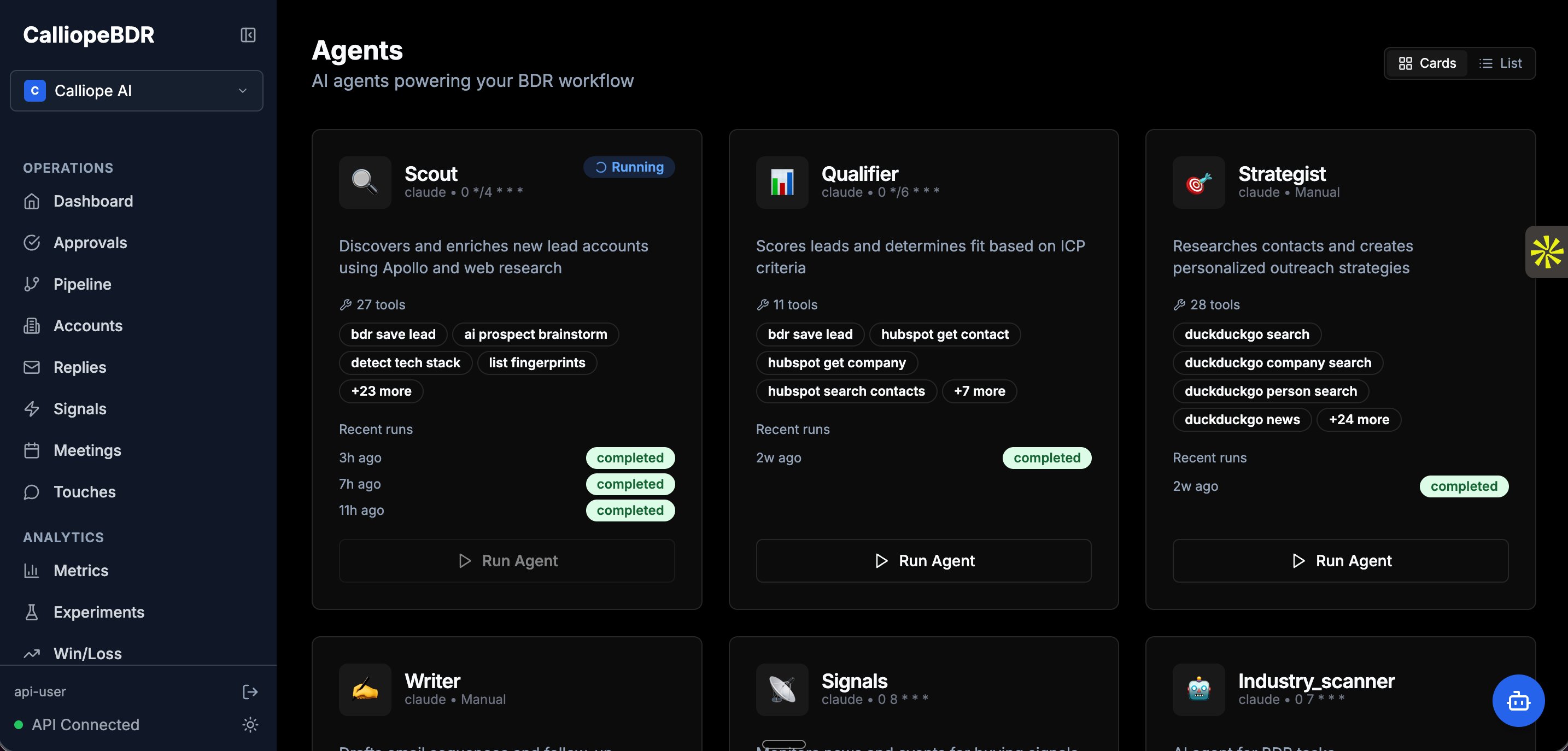
Proprietary multi-agent BDR framework
A production AI revenue system I architected on Claude API, integrated with Clay, Apollo, Perplexity, Gong, Clari, and 6sense. Seven custom agents cover the full top-of-funnel motion: a scout for account discovery and enrichment, a qualifier for ICP scoring, a contact researcher for persona mapping, a writer for personalized outreach, a signal monitor for buying triggers, an industry scanner for market intelligence, and a champion tracker for deal-level stakeholder identification. Not tooling adoption. System architecture.
Impact
Enabled a 3-person commercial team to run an enterprise sales motion typically requiring 12+ headcount. Validated $140K ACV with 40% conversion from enterprise design partner to paid pilot. Demonstrates what AI-native GTM operations look like in practice.
SPORT5 revenue operations framework
A structured approach to revenue operations that distinguishes between GTM models (strategic choices) and revenue flow models (operational systems). Five pillars: Strategy, Process, Organization, Revenue flow, and Technology, with five execution layers underneath. Used to diagnose why revenue infrastructure doesn't match how revenue actually flows.
Impact
Applied across multiple organizations to diagnose why revenue infrastructure did not match actual revenue flow, leading to GTM restructuring that improved pipeline predictability and sales cycle efficiency.